
The short answer
Start small. Pick four or five daily tasks that take about 15 minutes (dishes, counters, a quick tidy and one load of laundry). Once that feels automatic, give each weekday one focus area, such as bathrooms on Monday and floors on Wednesday. Add a short monthly list for slow jobs like baseboards and appliance filters. Most homes stay clean on 15 to 30 minutes a day this way.
Safety first
- Never mix bleach with vinegar, ammonia or other cleaners. The fumes can be toxic.
- Open a window or run a fan while you clean bathrooms and ovens.
- Keep cleaners in their original, labeled bottles, away from children and pets.
Most cleaning routines fail for the same reason: they start too big. A colorful chart with forty tasks looks great on the fridge and lasts about nine days.
The routines that last are boring on purpose. A few small daily habits keep the house working, one focus task a day keeps it clean, and a short monthly list catches the slow jobs before they pile up. Here is how to set that up, step by step, in a way that fits a busy week.
Why most cleaning routines fail
Before building a new routine, it helps to know what usually breaks the old one.
- All or nothing thinking. If the plan only works when you have a free afternoon, it won't survive a normal week.
- No clear end point. "Clean the kitchen" can take ten minutes or two hours. Without a defined finish line, it feels endless, so it gets put off.
- Too many decisions. Standing in the hallway wondering where to start uses up the energy you meant to spend cleaning.
- Catch up spirals. Miss two days, try to do three days of work at once, burn out, give up.
A good routine solves all four. It is small, every task has a clear finish, the decisions are made in advance, and missing a day costs nothing.
Step 1: Pick your daily basics
Start with only the tasks that stop the house from sliding. For most homes, that is four or five jobs that take about 15 minutes in total:
- Dishes. Load the dishwasher after dinner and run it, or wash what's left in the sink.
- Kitchen counters and stove top. A quick wipe with a damp cloth and a little dish soap.
- A quick 10 minute tidy. Set a timer and put things back where they live in the main living area.
- One load of laundry. Start it in the morning, move it to the dryer at lunch or after work, fold it in the evening.
- A quick bathroom wipe. Thirty seconds on the sink and faucet while you brush your teeth.
Do only this list for the first two or three weeks. It will feel too easy. That's the point. You are building the habit, not the clean house. The clean house follows.
Make the daily list automatic
Tie each task to something you already do every day. Wipe the bathroom sink right after brushing your teeth. Start the laundry before you make coffee. Do the 10 minute tidy while the kettle boils or right after dinner. When a task is attached to an existing habit, you stop having to remember it.
Step 2: Give each weekday one focus task
Once the daily list runs on autopilot, add one focus area per weekday. Each one takes 15 to 30 minutes, so the weekly cleaning never eats a whole Saturday.
| Day | Focus task | What it includes |
|---|---|---|
| Monday | Bathrooms | Toilets, sinks, mirrors, a quick shower wipe and the floor |
| Tuesday | Dusting | Surfaces, shelves, electronics, ceiling fans and baseboards |
| Wednesday | Floors | Vacuum every room and mop the hard floors |
| Thursday | Bedding and towels | Change the sheets, wash towels and bath mats |
| Friday | Kitchen | Wipe appliance fronts, clean the microwave, clear out the fridge |
| Saturday | Catch up | Anything you skipped this week, or nothing at all |
| Sunday | Plan and reset | Plan meals, do the 10 minute tidy, get ready for Monday |
The order is flexible. If you work from home on Wednesdays, put the biggest job there. If Friday evenings are busy, move the kitchen to Thursday. What matters is that every area has a day, so nothing gets skipped for a month.
Keep the tools in one place
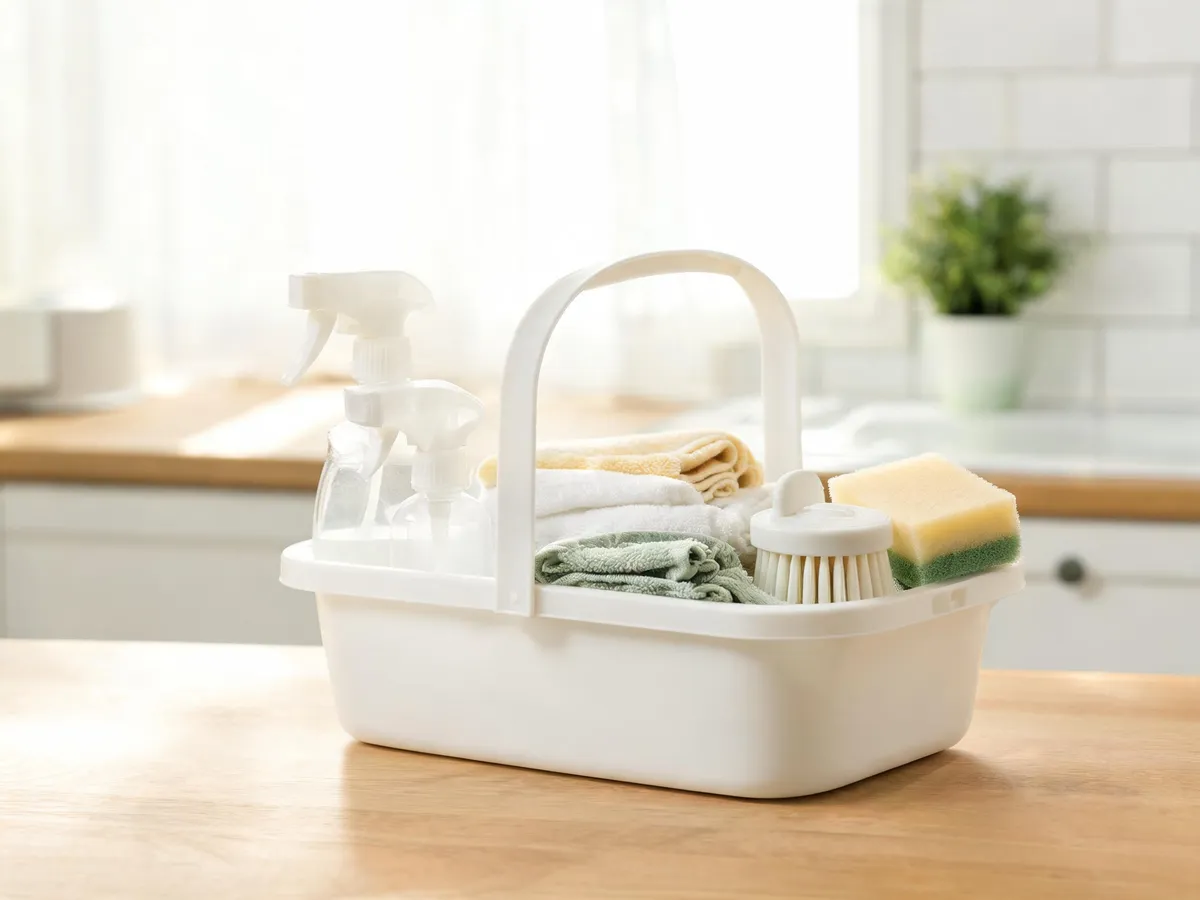
A cleaning caddy saves more time than any product. Keep a general purpose spray, glass cleaner, a scrub brush, a few microfiber cloths and gloves together, and carry the caddy from room to room. You make one trip instead of five.
Step 3: Add a short monthly and seasonal list
Some jobs don't need doing every week, but they quietly build up if they never get done. Give them a monthly slot, one or two per weekend:
- Wash light switches, door frames and the walls around them
- Wipe the baseboards
- Clean the washing machine and the dishwasher filter
- Polish stainless steel appliances
- Wipe kitchen cabinet fronts and handles
- Vacuum upholstery and under the sofa cushions
Seasonal jobs (windows, curtains, the mattress, a deep clear out of closets and the pantry) can go on a list you look at four times a year. Put them in your calendar for the first weekend of each season so they don't rely on memory.
Sample cleaning schedules for different homes
There is no single right schedule. Here are three starting points you can adjust.
Daily, weekly and monthly schedule
This is the full version from the steps above: about 15 minutes of daily basics, one 15 to 30 minute focus task each weekday, and one or two monthly jobs at the weekend. It suits most family homes.
Cleaning schedule for working parents
Keep the daily list to three tasks: dishes, counters and a quick 10 minute tidy with the kids helping. Combine the weekly tasks into two slightly longer sessions, for example bathrooms and dusting on Tuesday evening, floors and kitchen on Saturday morning. Give each child one small daily job, like setting the table or putting shoes away. Our chore chart maker suggests jobs that suit each age.
Small apartment version
In a small space, most weekly tasks take ten minutes or less. Do the daily basics, then pick three focus days instead of five: bathroom and floors on one day, kitchen and dusting on another, bedding and laundry on a third.
Clean each room in the right order
Whatever the schedule, the method inside each room is the same: work from top to bottom and from dry to wet. Dust the high shelves and light fixtures first, then wipe counters and fixtures, and do the floor last. Dust and drips fall down, so cleaning in this order means you never redo a surface.
The CDC notes that cleaning with soap or detergent and water removes most germs from surfaces, and that disinfecting is mainly needed when someone in the home is sick. For an everyday routine, a good general purpose cleaner and a microfiber cloth do most of the work.
When you do use a disinfectant, read the label. The EPA advises following the product directions, including how long the surface must stay wet to work. And never combine products: mixing bleach with vinegar, ammonia or other cleaners can release toxic gas.
How to stick with your cleaning routine
- Use a timer. "Clean until the timer goes off" is easier to start than "clean the kitchen."
- Lower the bar on hard days. On a rough day, do only the dishes. A small win keeps the habit alive.
- Don't catch up. If you miss Tuesday's dusting, skip it and do Wednesday's floors. Tuesday comes round again.
- Share the list. Put the schedule where everyone can see it, so the routine belongs to the whole household.
- Review after a month. If a task is always skipped, it is in the wrong slot or doesn't need doing that often. Move it or drop it.
Your printable cleaning schedule
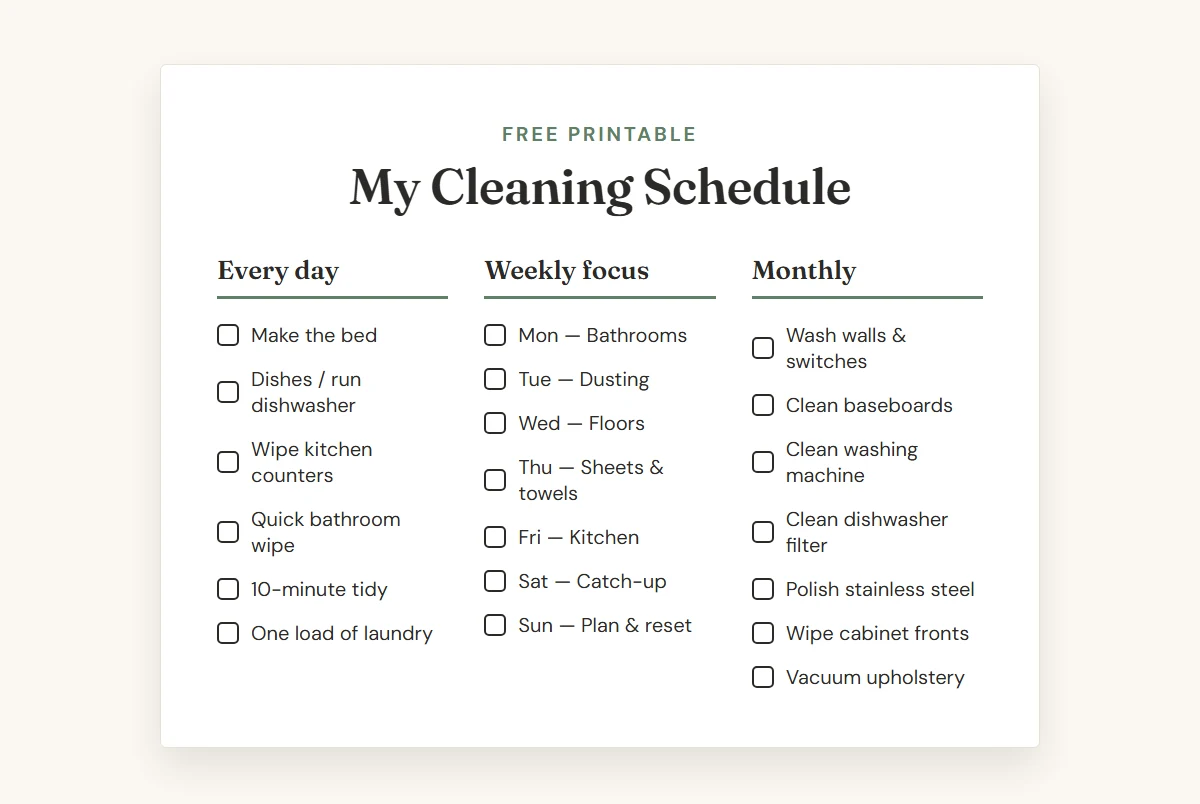
Here is the whole routine on one page: the daily basics, the weekly focus days and the monthly jobs. Print it and stick it on the fridge or inside a cupboard door, and tick things off as you go.
Want a version that fits your home? Our free schedule maker builds one from your rooms, your cleaning days and the time you have.
For more routines and checklists, browse the cleaning schedules and routines section. If you'd like to know where our advice comes from, read how we write our guides.
Common questions
How long should a cleaning routine take each day?
For most homes, 15 to 30 minutes a day is enough. That is about 15 minutes of daily basics plus one focus task from your weekly rotation. Homes with young children or pets may need a little longer.
What should I clean every day?
Keep the daily list short: wash or load the dishes, wipe the kitchen counters and stove top, do a quick 10 minute tidy of the main living area, and run one load of laundry if your household needs it.
How often should I deep clean my house?
A seasonal deep clean, about four times a year, works for most homes. A weekly rotation and a short monthly list keep the basics under control, so each deep clean stays manageable.
What order should I clean a room in?
Work from top to bottom and from dry to wet. Dust high surfaces first, then wipe counters and fixtures, and finish with the floor, so dust and drips never land on a surface you have already cleaned.
What if I fall behind on my cleaning schedule?
Skip what you missed and do today's task. Trying to catch up on several days at once is the most common reason routines get abandoned. The missed area will come round again next week.
Sources
- When and How to Clean and Disinfect Your Home, Centers for Disease Control and Prevention (CDC)
- Six Steps for Safe & Effective Disinfectant Use, U.S. Environmental Protection Agency (EPA)
This guide is general cleaning information. Always follow the product label and your manufacturer’s care instructions, test on a hidden spot first, and never mix bleach with vinegar, ammonia or other cleaners.
Reviewed by Clara, Founder and editor, on . How we research and check articles.